
COLOR VISUALIZATION OF THE TRAJECTORY IN A RUNNING STRIDE
Introduction
A running stride is the fundamental unit of running motion. It represents a dynamic, cyclic movement that reflects a runner’s biomechanics and overall efficiency. Monitoring stride patterns enables athletes to make targeted adjustments and gain a clearer understanding of each component of the movement. For evaluation purposes, the complete stride cycle is divided into phases, which are presented using a color-coded visualization scheme as follows.
Content Overview
1. Phases of the Running Stride
2. Phase-Based Foot Motion in Static Kinogram Analysis
3. Phase-Based Foot Motion in Dynamic Observation
4. Trajectory-Based Technique Evaluation
5. Conclusion
1. Phases of the Running Stride
The running stride is divided into phases to make movement analysis clearer and more systematic. This approach allows precise observation of body mechanics and supports accurate evaluation and targeted performance improvement.
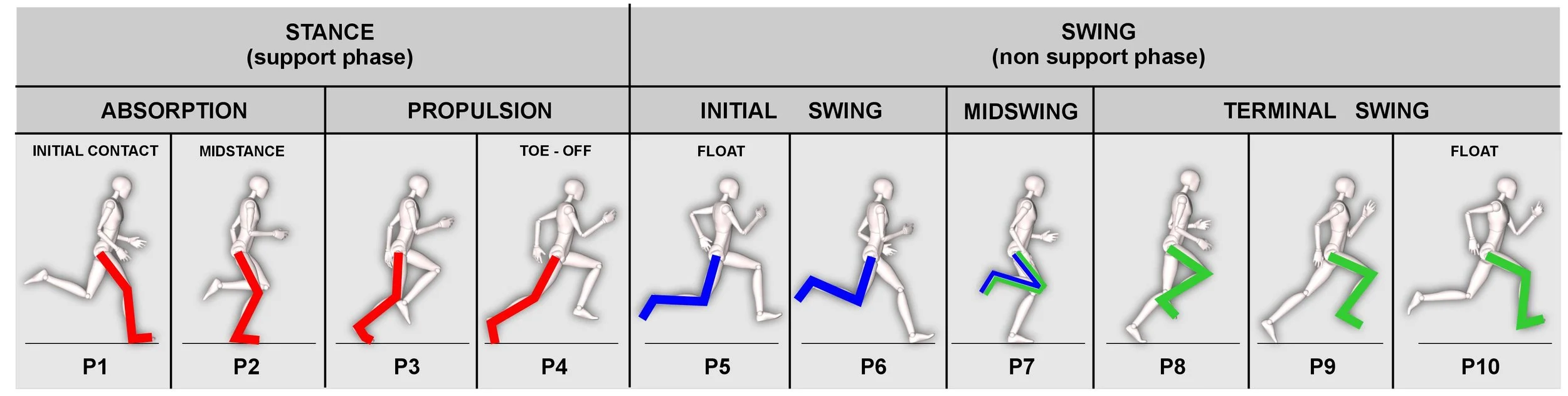
The figure above shows the full running cycle. Each position is labeled, with the leg highlighted in a color corresponding to that phase. Color coding enables precise analysis of specific stride segments, which will be used in our subsequent analysis.
Stance Phase — Red
The stance phase occurs when the foot is in contact with the ground. It begins at the moment of initial contact and ends at toe-off. During this phase, the leg supports the body's weight, absorbs impact forces, and stores elastic energy that contributes to forward propulsion. This is the only part of the stride where the foot is stationary relative to the ground.
Initial Swing — Blue
Initial swing begins as soon as the foot leaves the ground after toe-off. The leg accelerates forward, and the hip and knee flex to lift the foot and clear the ground. This phase is essential for preparing the leg for forward progression.
Terminal Swing — Green
Terminal swing is the final part of the swing phase. Here, the leg extends forward and the muscles work to control and decelerate the limb in preparation for the next ground contact. Proper control in terminal swing ensures a smooth transition into the stance phase, reduces braking forces, and minimizes injury risk.
2. Phase-Based Foot Motion in Static Kinogram Analysis
By applying color-coded stride phases to specific body parts, we can better understand their movement. While this approach can be applied more broadly, in this study we focus on the foot
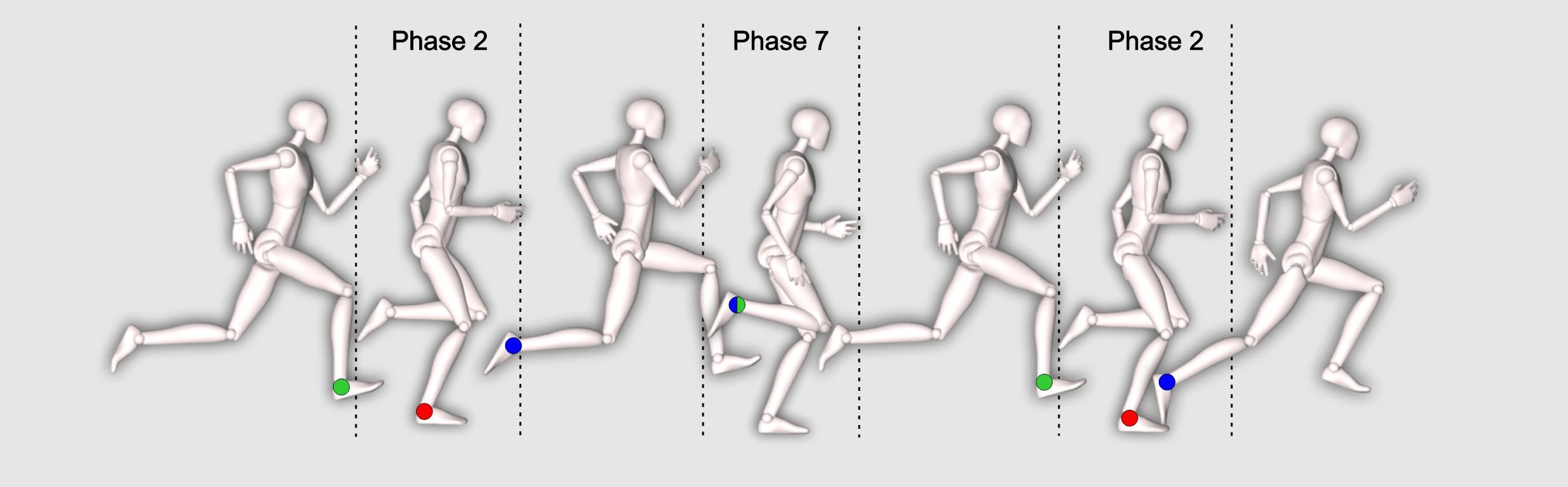
The figure shows the selected point on the foot, marked with the color corresponding to its stride phase.
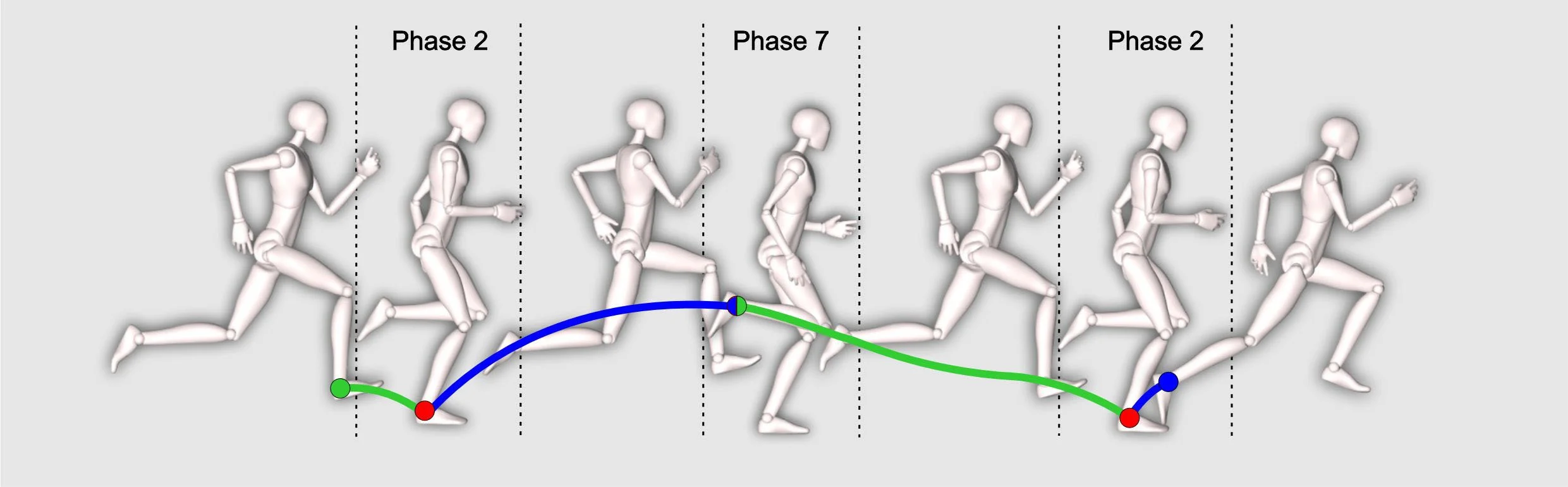
Connecting these points along the motion curve produces a trajectory: the Initial Swing phase is shown in blue, the Terminal Swing phase in green, while the red phase appears as a single point because the foot remains stationary during stance. This trajectory illustrates the foot’s motion throughout the stride, clearly distinguishing dynamic phases as curved lines and static phases of ground contact as single points.
4. Phase-Based Foot Motion in Dynamic Observation
Observation of running motion with color-coded phase markers, as described previously, can be presented through two approaches.
The first approach uses a static camera while the runner moves through the frame. In this case, the color-coded foot point forms an open curved trajectory.
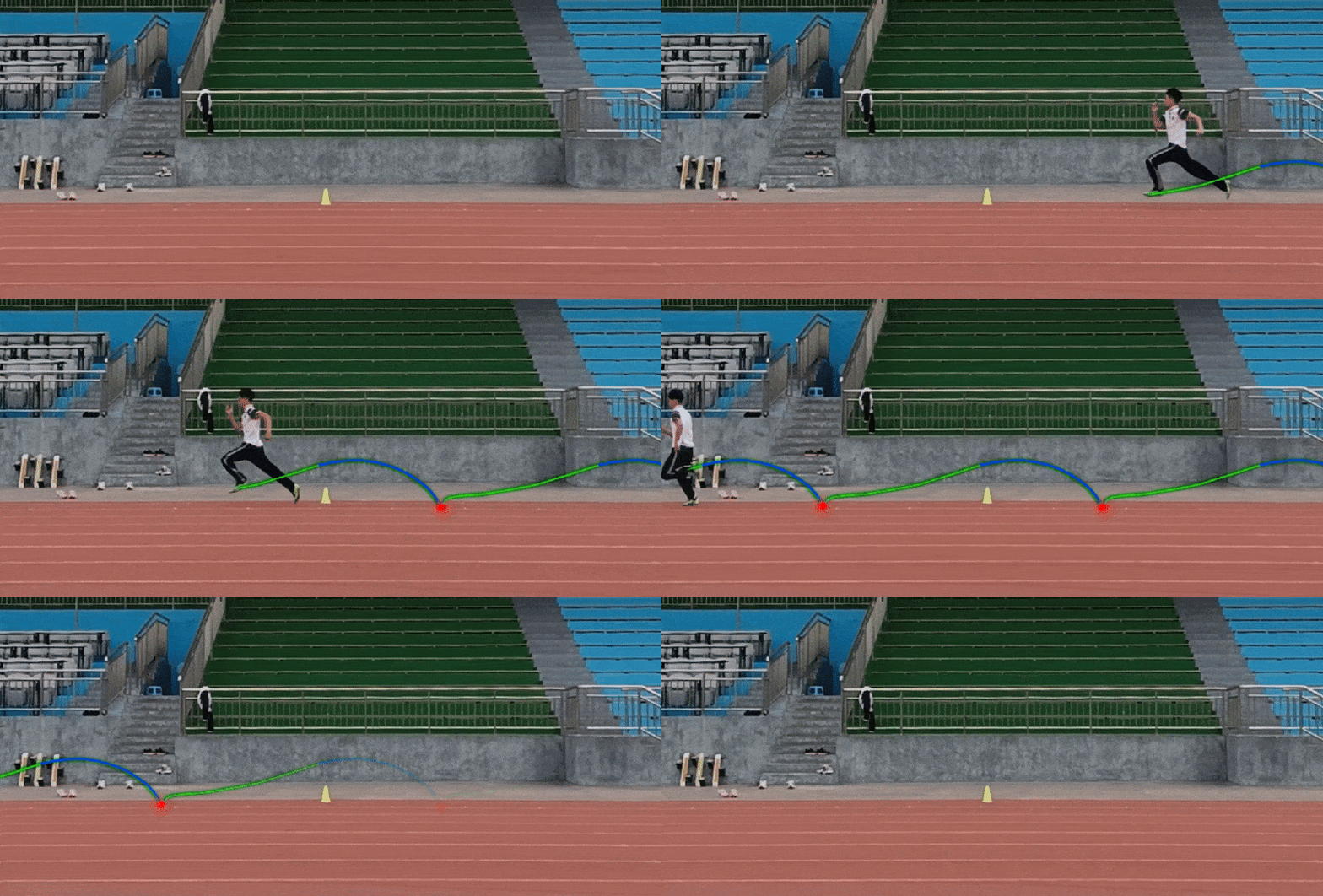
The second approach uses a moving camera that follows the runner at approximately the same speed and in the same direction. Under these conditions, the color-coded trajectory of the tracked point forms a closed curve.
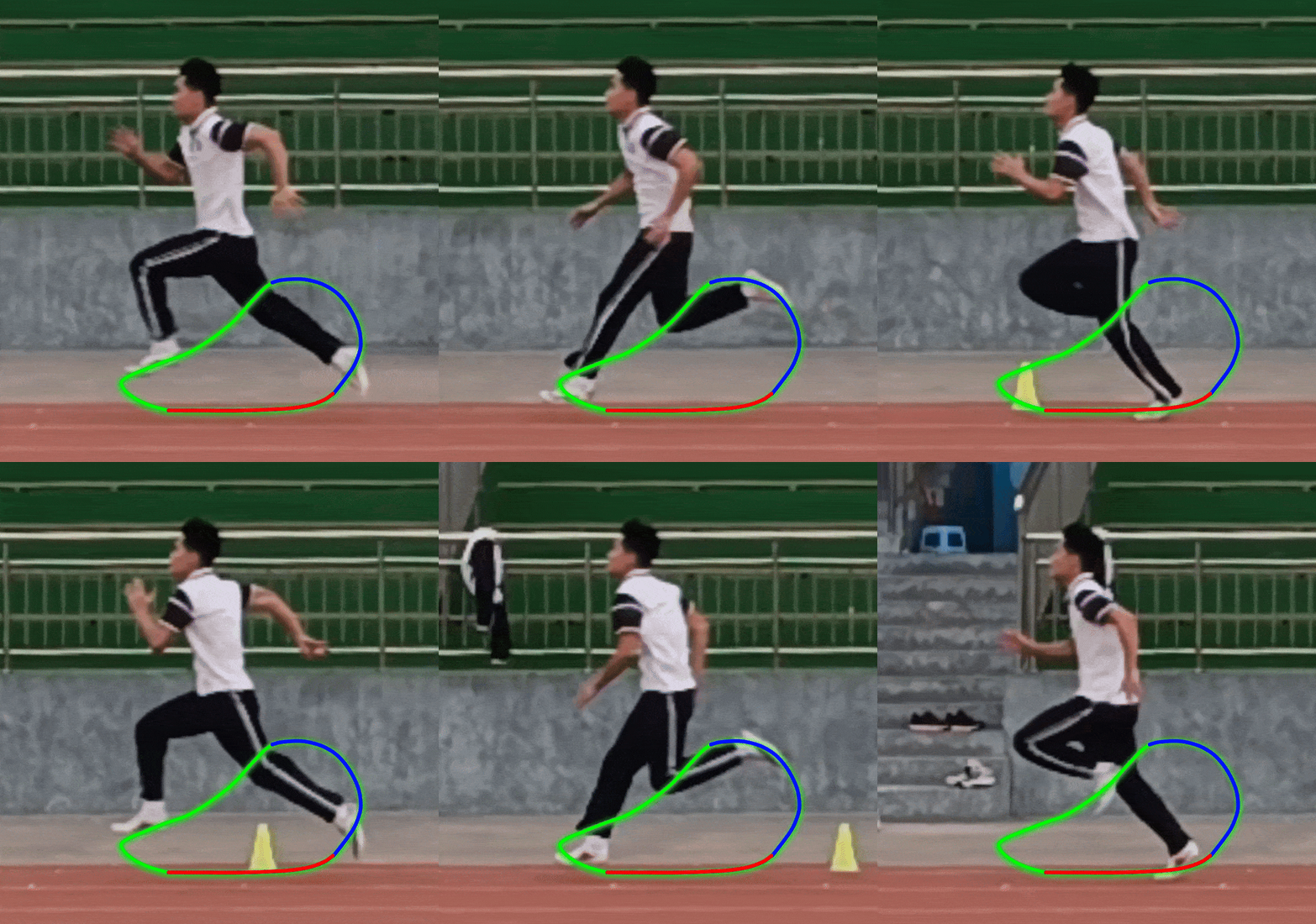
In this approach, the red segment corresponds to the stance phase and appears as a nearly flat portion of the curve because the foot remains in ground contact with minimal displacement relative to the runner.
In both approaches, variations in curve shape and segment deviation directly reflect running technique. The shape, length, and deviation of each colored segment create a unique motion pattern for each runner. Any change in technique produces visible differences in the trajectory pattern, whether observed as an open or closed curve.
4. Trajectory-Based Technique Evaluation
The proposed color-coded trajectory method enables comparison between runners by analyzing the shape and structure of their motion curves. Examination of curve geometry, segment length, phase distribution, and deviation patterns allows identification of technique-specific characteristics and provides a visual and measurable basis for performance evaluation and targeted correction.
5. Conclusion
This paper presents a color-coded, phase-based method for visualizing foot motion during the running stride using kinogram and dynamic video analysis. Mapping stride phases onto trajectory curves enables clear phase identification and structured movement comparison. The approach provides a practical visual framework for running technique evaluation and performance-oriented analysis.